Quiz on 🌌 “Supernovae” — the spectacular explosions of dying stars.
Quiz on 🌌 “Supernovae” — the spectacular explosions of dying stars.
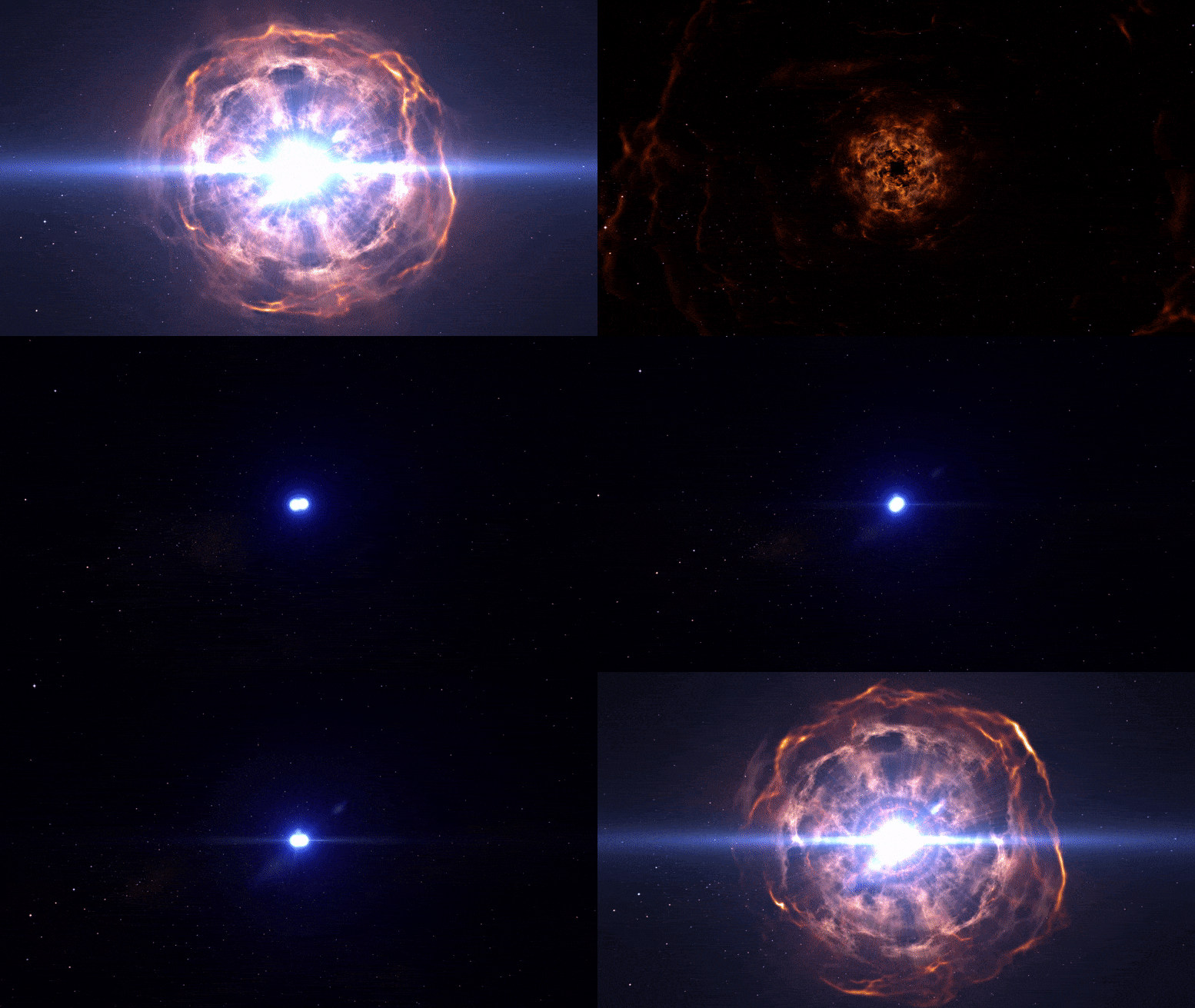
A supernova is a powerful and luminous explosion that occurs at the end of a star’s life cycle. There are two main types: Type I, which occurs in binary systems when a white dwarf accumulates too much mass from its companion star, and Type II, which happens when a massive star exhausts its nuclear fuel and its core collapses. Supernovae release enormous amounts of energy and light, often outshining entire galaxies for a short period. They also produce heavy elements, such as iron and gold, which are scattered into space, enriching the interstellar medium and contributing to the formation of new stars and planets. Famous supernovae include SN 1987A in the Large Magellanic Cloud and Tycho’s Supernova observed in 1572. Studying supernovae helps astronomers understand stellar evolution, cosmic distances, and the chemical enrichment of the universe.
Ready for the Quiz?
Please read the instructions below carefully before you begin. These rules ensure a fair and smooth experience.
Total Questions: 10
Each question has 4 options out of which only one option is correct. After attempting all the questions, click on Submit button to submit the response.
Once your responses are stored. You will be able to view the leaderboard of this quiz.